Skip to content
BIHMARKETING

Service · Growth

Market Research and Competitor Analysis in Bosnia and Herzegovina

Before you invest in ads, a website or a new product — find out who your customers are, what they look for and where the competition leaves you room.

Market Research

The most expensive mistake in marketing is a good campaign for the wrong message. Market research is what we do before the first ad: we check who your customers are, how many there are, what they care about, what they are willing to pay and what competitors already offer them.

We don't do research that ends up in a drawer. Every finding leads to a decision: who we speak to, with which message, through which channels, on what budget and how we will measure results. That is why our research is always tied to a marketing strategy.

We combine methods: Google demand analysis (how many people search and exactly what for), competitor analysis (websites, ads, prices, social media, reviews), surveys and short interviews with existing and potential customers, and data from your own channels — sales, enquiries, analytics.

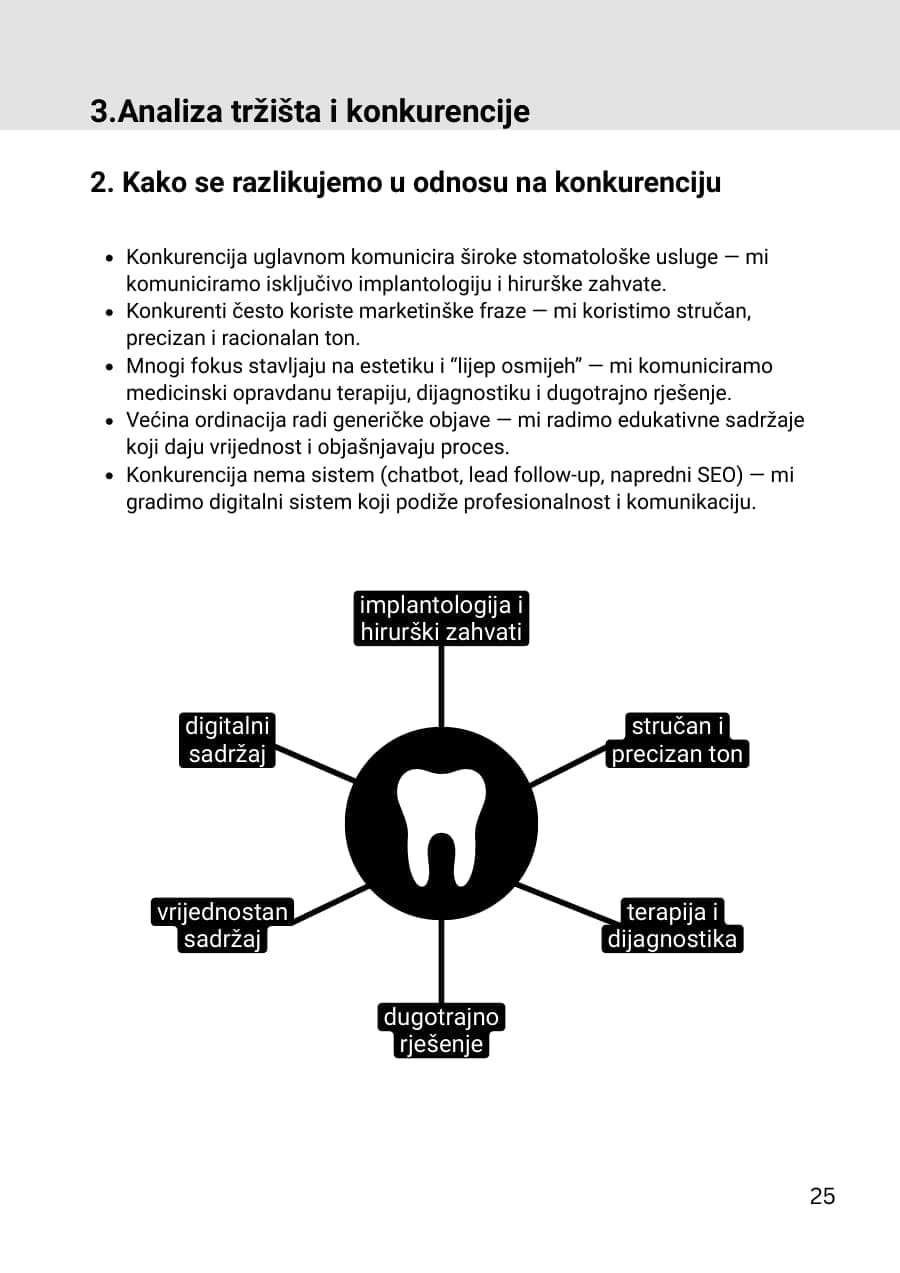
For JUN Water, a new sports water brand, research into the market, distribution and product economics was the foundation of a 40-page business plan and marketing strategy. For Dr. Edin Bukva's clinic, competitor analysis was part of the 87-page strategy that all communication is built on.

The result is a report you can read in half an hour and a presentation where we make decisions together. For a quick start, our free AI brand analysis shows in a minute how customers and Google see you — real research goes much deeper.

Why market research comes before the campaign

Every campaign rests on assumptions: who buys, why they buy, what they will pay and what competitors offer them. If one of those assumptions is wrong, even the best ad won't help — it just spends the budget faster.

Market research turns assumptions into data. It doesn't have to be big or expensive: often it is enough to see what people actually search for, what the three closest competitors do and to talk to a dozen customers to set the message and budget right.

  • Before launching a new product or service
  • Before entering a new market or city
  • When ads spend but enquiries stay low
  • Before a rebrand or a price change
  • Before building a new website

How we research a market

We combine quick, low-cost methods with deeper conversations with customers. We start with data that already exists — your sales, enquiries and analytics — and add what customers and the market show us.

  • Demand analysis: how many people search Google for your products, in which words and in which cities
  • Competitor analysis: websites, messages, prices, ads, social media and reviews
  • Surveys of existing and potential customers
  • Short customer interviews: why they bought, why they didn't, what stopped them
  • Social listening: what people say about your category
  • Your data: sales, enquiries, website and ad analytics

From data to a plan

Research only makes sense if it turns into decisions. So every project ends with a concrete plan: who we speak to, with which message, through which channels, on what budget and by which numbers we measure success.

For Dr. Edin Bukva, competitor and patient analysis was the basis of an 87-page strategy; for JUN Water, research into the market and distribution became a 40-page business plan and marketing playbook.

How we work — step by step

  1. 01

    The question

    We define the decision the research must support — e.g. entering a new city or a new price.

  2. 02

    Existing data

    Your sales, enquiries and analytics, plus public market data.

  3. 03

    Demand and competitors

    Google searches, social media, competitor offers and prices.

  4. 04

    Customers

    Surveys and short interviews with existing and potential customers.

  5. 05

    The plan

    Report, customer profiles and a recommendation: message, channels, budget, measurement.

What you get

  • Demand analysis (Google and social media)
  • Review of 3–5 key competitors
  • Survey and interview results
  • Customer profiles
  • Recommendation: message, channels and budget
  • Presentation and next-step plan

Signs of good market research

  1. 01It starts from a concrete business decision
  2. 02It combines data with customer conversations
  3. 03It shows what competitors do, not just who they are
  4. 04It ends with a recommendation, not just tables
  5. 05It can be read in half an hour
  6. 06It turns into a campaign you can measure

Work for this service

Clients who trust us

  • Herbisa
  • Deltron
  • British American Tobacco
  • KJKP Vodovod i Kanalizacija
  • iNovine
  • Yubacom
  • Gree
  • Azuri
  • Mitsubishi Electric
  • Sky Nekretnine
  • Relax Tours
  • Sport Centar
  • Kvart Nekretnine
  • KJKP RAD
  • KULT Institut
  • GLO
  • ENCOS
  • Estesa Clinics
  • Zavod ZZ MUP KS
  • JP Onsa
  • Pino Nature Hotel
  • 5 Travel
  • Academy Residences
  • Bulevar Ljepote
  • Velora Beauty Salon
  • Dr. Edin Bukva
  • JUN Water
  • Euro Kula
  • WorkEU
  • Lincontro
  • Foto Jotić
  • DracoMom
  • SheWonder
  • QR eMenu
  • BH Calls
  • Modeli Autica
  • NR Rent
  • Duo Rent a Car
  • Standard Accounting
  • Stones Ceramic Solutions
  • CNC Academy
  • VC Servis
  • MoveLed
  • Inoxoprema
  • Kombi-line
  • Cut & Stitch
  • Kozzka Studio

FAQ

How long does market research take?

A quick competitor and demand analysis takes 1–2 weeks. Research with customer surveys and interviews usually takes 3–5 weeks, depending on the number of respondents and markets.

Do small businesses need market research?

Yes, at a smaller scale. A small business should still know what people in its city search for, what a click costs in its niche and how it differs from its three closest competitors. That often saves more than it costs.

Do you research new markets or new products?

Yes. For a new product or market entry we estimate demand, competition, pricing and sales channels, and recommend whether, how and on what budget to enter.

What do I get at the end?

A report with findings and recommendations, customer profiles, a competitor overview and a concrete plan: message, channels, budget and measurement. We present it live and answer questions.

Can I try something for free first?

You can run our free AI analysis of your brand and website. It shows how customers and Google see you based on your homepage; market research then goes deeper into customers, competitors and demand.

How many respondents does a survey need?

For a local business, 50–150 responses and about ten interviews often reveal clear patterns. For larger markets and new products we set the number by the research goal.

Can I get just a competitor analysis?

Yes. Competitor analysis is the most common first step and can be done on its own, as a basis for a website, ads or a rebrand.

Related services

Next step

Got a budget and ambition? Let's talk.

30 minutes, no obligation. Tell us where the business is today and where you want it to be — we'll tell you how we would get it there.